Months ago, you got the “we went with another candidate” email. You did the right thing: closed the loop politely and moved forward. Now a new role pops up at the same company and you think, I could do that job. You are not being awkward. You are doing what strong candidates do: staying in the mix.
I’ve hired for nursing and remote tech roles where timing mattered as much as talent. Sometimes the “no” was real. Sometimes it was simply a better match, a budget shift, an internal candidate, or a team change that had nothing to do with the person I rejected. Reconnecting well is about making it easy for the recruiter to say “yes, let’s revisit.”

When to reconnect
Reaching out months later works best when you have a clear reason and a clean ask. Good reasons include:
- A new opening is posted that is the same track or a better fit than the role you were rejected from.
- You gained something new since you last spoke: certification, license, portfolio project, leadership responsibility, measurable results.
- You had a strong process (good feedback, late-stage interviews, “keep in touch” language) even if you did not get an offer.
- You were a close second (a “silver medal” candidate) and the recruiter hinted the team liked you but chose someone else.
It is usually not worth re-engaging if you were rejected after an auto screen, applied and never spoke to anyone, or the role you want is wildly different from your background.
One exception: if you now have a clear advocate (a referral, a hiring manager you met, or an internal contact) or the new role is niche and you match it unusually well, a short, well-targeted note can still be worth it.
What to reference
Your goal is to jog the recruiter’s memory in one sentence, then pivot to the present. Reference only what helps them place you quickly.
Include
- The role and timing: “We spoke in March about the RN Case Manager role.”
- A connection point: a panel interview, a phone screen, or something specific you discussed (one detail is enough).
- What has changed: a new credential, a performance win, a relocation, updated clearance, a specialized skill.
- The role you want now: the exact job title and the job ID if available.
Avoid
- Re-litigating the rejection: do not argue why they were wrong.
- Asking for a “second chance” as the core framing. Keep it businesslike: you are expressing interest in a current opening.
- Long backstory: no one has time for it in an inbox.
- Guilt language: “I never heard back” or “I really need this.”
How short to be
I coach clients to keep this kind of note to 6 to 10 sentences. Think “easy yes.” Use this structure:
- Subject line: Name + role + quick reason
- Memory anchor: when you last connected and for what
- New value: one or two recent wins relevant to the new opening
- Clear ask: “Would you be open to a 10-minute call?” or “Is it best to apply through the posting?”
- Convenience: updated resume/LinkedIn/portfolio link and a couple of time windows
If you do not have new accomplishments since the rejection, you can still write, but you will need to be extra crisp about fit. The recruiter is thinking: What is different now? Give them something, even if it is a clearer match to this specific opening.
Apply or message first?
If the posting is live and you are confident you match it, I usually recommend doing both on the same day:
- Apply through the official posting (ATS and compliance matter, and many recruiting teams cannot move you forward without an application, although the workflow varies by employer).
- Then message the recruiter with a simple flag: “I just applied for Telehealth Support Engineer (Req 1842) and wanted to share two quick fit points.”
If you are unsure you meet a hard requirement, message first with a short question. This can save you time and help you avoid applying into an automatic screen when the answer is clearly “not eligible yet.” If they say “apply through the portal,” do that and keep it moving.
Timing
How long after a rejection?
- 3 to 6 months often works well for a general check-in, especially if you had interviews.
- Any time can be reasonable if there is a new job posting you are a strong match for.
Think of these as guidelines, not rules. If a new posting just went live and you match it well, it is usually better to move quickly than to wait for a “perfect” interval.
What day and time?
Recruiters often have meeting-heavy calendars, so many candidates find it helps to send a note early in the morning in the recruiter’s time zone, or late afternoon. Do not overthink it. Quality matters more than perfect timing.
How many follow-ups?
As a general norm, one follow-up is enough. Here is a clean approach:
- Message #1: your check-in note
- Wait 5 to 7 business days (or a full week if you are contacting during a holiday stretch)
- Message #2: a short bump with one new detail (or a simple “just resurfacing this in case it got buried”)
- Then stop unless they respond or you have a truly new development
Company policies
Some employers have internal policies that shape how you should re-approach, even if the recruiter liked you:
- Cooling-off periods: some teams prefer waiting a set number of months after a rejection before reconsidering. Other teams do not.
- ATS-only workflow: some companies require every candidate to reapply through the ATS for each req, even if you interviewed recently.
- Internal mobility priority: some openings are posted externally while the company is still reviewing internal candidates first.
This is why a low-pressure ask like “Is it best for me to apply through the posting?” works so well. It respects their process.
Email scripts
1) For a new opening
Subject: Reconnecting: Telehealth Support Engineer (Req 1842)
Hi Jordan,
We spoke in February about the Support Engineer role on the Telehealth team. Thanks again for your time back then.
I noticed the new opening for Telehealth Support Engineer (Req 1842) and wanted to reach out because I’m a strong match for troubleshooting and customer escalations. Since we last connected, I led a rollout that reduced ticket backlog by 28% and I’ve been handling tier-2 on-call support weekly.
Is it best for me to apply through the posting (I’m happy to do that today), or are you able to review an updated resume directly?
Best,
Maya Patel
LinkedIn: linkedin.com/in/mayapatel
2) Without a posting
Subject: Quick check-in since our interview last spring
Hi Jordan,
I hope you’ve been well. We connected in April regarding the RN Care Coordinator role.
I’m still very interested in your team’s work, and I wanted to share a quick update: I recently completed CCM coursework and I’ve been supporting a higher-acuity caseload with a focus on reducing avoidable readmissions.
If you expect any openings in the next month or two, I’d love to be considered. If not, no worries at all, I appreciate you keeping me in mind for future roles that fit.
Best,
Maya Patel
LinkedIn: linkedin.com/in/mayapatel
LinkedIn messages
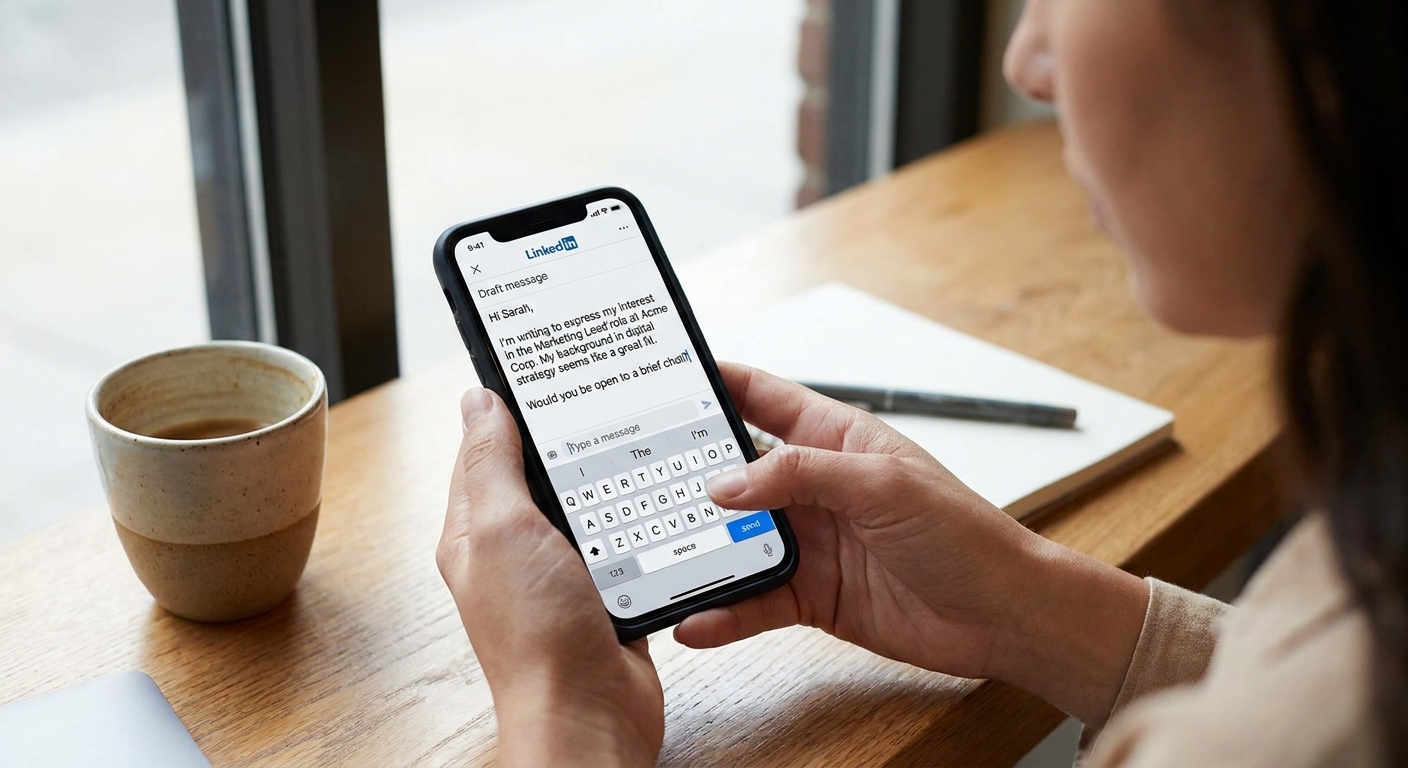
LinkedIn is great when you previously messaged there, or when the recruiter is very active. Keep it tighter than email.
Option A: New opening
Hi Jordan, we spoke in February about the Support Engineer role. I saw the new Telehealth Support Engineer posting (Req 1842) and wanted to ask if you’re the right contact. Since then I led a rollout that cut backlog 28% and I’m doing tier-2 on-call weekly. Would you be open to a quick chat, or is it best to apply through the posting?
Option B: Simple check-in
Hi Jordan, hope you’re doing well. We connected in April about the RN Care Coordinator role. Quick update: I’ve taken on a higher-acuity caseload and completed CCM coursework. If anything similar opens up soon, I’d love to be considered. Either way, thanks for keeping me in mind.

If you got feedback
If a recruiter or hiring manager gave you a real reason (even a small one), use it. Keep it factual and forward-looking:
- Reference it briefly: “You mentioned the team needed more experience with Zendesk reporting and SLA management.”
- Show what you did: “Since then, I built a weekly SLA dashboard, partnered with engineering on two root-cause fixes, and we improved first-response time from 3 hours to 90 minutes.”
- Bring it back to the opening: “That’s why I’m excited about this new role.”
This is one of the cleanest ways to answer the recruiter’s unspoken question: What is different now?
If a requirement was missing
This is where a re-approach can be especially effective, as long as you address the gap directly.
- If the gap is now closed: name it clearly. “I now have my multistate/compact RN license (if applicable in my state).”
- If the gap is partially closed: be honest and show a plan. “I’m scheduled to sit for Security+ next month.”
- If the gap is still open: consider applying without outreach, or wait. Repeatedly asking before you meet a hard requirement can, in some environments, burn goodwill.
Note for veterans
When I helped my brother transition out of the service, one of the biggest hurdles was translating experience into the employer’s language. If you were rejected earlier and you are reaching out again, make your update easy to understand:
- Translate roles into outcomes: “led a 6-person team” plus what you delivered, on what timeline.
- Clarify availability and location: terminal leave dates, relocation, remote readiness.
- Use civilian equivalents: certifications, tools, and systems the company actually uses.
Your check-in is not the place to explain your entire service history. It is the place to show you are qualified for this opening now.
When silence means stop
This part is tough, but it protects your confidence and your professional reputation.
As a practical rule of thumb, it is usually time to stop after:
- No response after two messages (your initial note plus one follow-up) across about 10 to 14 business days.
- You receive a clear no (“we’re not moving forward” or “please apply online only”). Take it at face value.
- The posting closes or you see the role has been filled.
- You keep contacting multiple people on the same team and no one engages. That can come off as pressure, even if your intentions are good.
Silence usually is not personal. It is bandwidth, competing priorities, or a role that is already far along. The most strategic move is to apply if the role is still open, then focus your energy on other opportunities.
Small details that help
- Share an updated resume unless the recruiter has explicitly said “no attachments.” If attachments are blocked, use whatever the company prefers (an ATS upload or a LinkedIn profile). If you share Google Drive or Dropbox links, make sure the employer allows them and that the link permissions are set correctly.
- Mirror the job title exactly as posted. Recruiters juggle many similar roles.
- Use one proof point that matches the new opening’s top requirement. Numbers help: time saved, backlog reduced, revenue supported, patients served, SLA met.
- Offer two time windows instead of asking “when are you free?”
- Keep your tone calm and confident. You are reconnecting, not begging.
Customization checklist
- Pull the top 2 requirements from the posting and mirror the language in one sentence (tools, license, domain).
- Add 1 measurable proof point that matches the role’s main pain point (speed, quality, volume, outcomes).
FAQ
Should I apologize for reaching out again?
No. A professional check-in is normal. If you want to acknowledge the time gap, a simple “I hope you’ve been well since we last spoke” is enough.
Is it better to email or call?
Email is usually best. Calling without an invitation can put a recruiter on the spot. If they respond and suggest a call, great.
What if I do not remember the recruiter’s name?
Try your calendar, old emails, or LinkedIn message history. If you still cannot find it, apply through the posting and reach out to the recruiter listed on the job post or a recruiting team member who covers that function. Avoid sending a generic blast to multiple recruiters at once.
What if the recruiter changed companies?
Then treat it like a fresh application. If you can find the new recruiter responsible for the role, your message should not assume prior context.
Final mindset
A rejection closes one hiring decision, not your entire relationship with a company. If you reconnect months later with a short note that references the past, highlights what is new, and makes a clear ask, you come across as steady and professional, which is exactly what recruiters like to see.
If you send the note, follow up once, and hear nothing, let that be your cue to redirect your energy. Your goal is not to convince one recruiter forever. Your goal is to keep moving toward stable, purposeful work with people who are ready to say yes.