
The first 10 minutes of an interview are usually not about trick questions or perfect answers. They are about basic signals: Are you prepared? Can you communicate clearly? Do you actually want this job? In my experience in admissions and recruiting, many hiring managers start forming a story quickly, and your job is to give them a good one to work with. The good news is that early impressions can be updated when you reset and finish strong.
Below are the most common early red flags I saw, plus exactly what to do if you realize you are slipping.

What hiring managers check early
Even in friendly interviews, most interviewers are quickly assessing four things:
- Professional baseline: punctual, appropriate appearance, respectful tone, basic manners
- Communication: can you answer a simple question without rambling or freezing
- Preparation: do you understand the role and why you are a fit
- Energy and alignment: do you seem engaged, coachable, and interested in this job, not any job
You do not need to be the most charismatic person they meet all week. You do need to be steady, clear, and ready.
Early red flags (and fixes)
1) You are late, or you act like time does not matter
What it can signal: poor planning, unreliability, or that you will be hard to manage.
In-person: showing up late, cutting it close (arriving exactly at start time and rushing in), or arriving flustered and blaming traffic.
Virtual: joining after the scheduled start time, struggling with links, or spending the first minutes troubleshooting audio.
Do this instead:
- Arrive 10 minutes early (unless instructions say otherwise) and wait nearby, then check in 5 minutes before.
- For virtual, join the platform 5 minutes early with camera and audio tested.
If you are late anyway, recover fast: keep it short, own it, and pivot.
- Say: “Thank you for your patience, and I am sorry for the late start. I am ready now and I appreciate your time.”
- Avoid: a long explanation, blaming a prior meeting, or joking about it.
2) Your opening answer is vague or unfocused
This shows up when the interviewer asks “Tell me about yourself” and you respond with your entire life story or a scattershot list of roles.
What it can signal: weak communication, low self-awareness, or unclear fit.
Do this instead: use a simple Present-Past-Point structure that takes 45 to 75 seconds.
- Present: what you do now (or most recently) in one sentence
- Past: 1 to 2 strengths backed by examples
- Point: why you are here and what you want to contribute
Example: “I am currently a customer support lead in a healthcare software company. Over the last three years, I have focused on coaching teams and improving response quality, including cutting escalations by 18%. I am excited about this role because it blends service leadership with process improvement, and I would love to bring that approach to your patient support team.”
3) You do not seem to understand the job
Hiring managers notice this immediately when candidates confuse titles, miss the core responsibilities, or ask questions answered in the first two lines of the posting.
What it can signal: mass-applying, low attention to detail, or that onboarding you will be harder than it needs to be.
Do this instead: before the interview, write down:
- The top 3 priorities of the role (from the job description)
- Your 2 most relevant examples for each priority
- One sentence on why this company specifically
Quick save if you blank: “I want to be transparent, I may be mixing this with another posting. Can I take 20 seconds to pull up my notes so I can answer you accurately?” Then do it. Accuracy beats pretending.
4) You speak negatively about a past employer too soon
You can be honest about a tough environment. The red flag is when the first few minutes are heavy on complaints, drama, or “everyone there was incompetent.”
What it can signal: poor judgment, low professionalism, or that you may bring conflict to the team.
Do this instead: keep it neutral, focus on the work, and pivot to what you learned.
- Try: “I realized I do my best work in an environment with clear priorities and consistent feedback. I learned a lot about staying organized, and now I am looking for a team where I can build long-term.”
5) Your energy is flat, or you come across as uninterested
This is not about being bubbly. It is about showing you can engage like a working colleague.
What it can signal: low motivation, burnout, or that you will disengage quickly after hiring.
Do this instead:
- Greet the interviewer by name and make eye contact (camera or in person).
- Match the interviewer’s formality and pace. Nervous fast-talking reads as frantic; slow monotone reads as checked out.
- Have 1 to 2 “why this role” sentences ready.
If nerves are the real issue: name it briefly and move on. “I am excited to be here, and I might sound a little nervous at first. I really appreciate the chance to talk today.” Then answer the next question.
6) You ramble, interrupt, or cannot land a point
In the first 10 minutes, interviewers are often deciding whether you will be easy to work with in meetings, on calls, and with patients or customers.
What it can signal: weak executive communication, weak listening skills, or lack of preparation.
Do this instead: answer most questions with CAR (a simplified version of STAR) :
- Context: what was happening
- Action: what you did
- Result: what changed because of it
If you catch yourself rambling: “Let me pause and summarize the key point.” Then give one sentence with the outcome.
7) You cannot give a clear reason for leaving (or you overshare)
What it can signal: risk, instability, or that you will be hard to retain.
Early red flags include talking at length about personal conflicts, mentioning legal issues unprompted, or giving a reason that does not match your resume timeline.
Do this instead: offer a concise, forward-looking reason and tie it to the role.
- “I am looking for a position with more growth in X, and this role stood out because…”
- “My team was reorganized, and I am focusing on roles where I can do Y.”
8) You are not ready for basic logistics
These often come early, especially in recruiter screens: schedule, shifts, salary expectations, location, start date, licensure, work authorization.
What it can signal: you did not think through the reality of the job.
Do this instead:
- Know your availability and any non-negotiables.
- Have a salary range ready based on your market, and practice saying it calmly.
- If you need accommodations, prepare a professional way to state it. If you can, share what you need as early as it becomes relevant to scheduling or essential job functions.
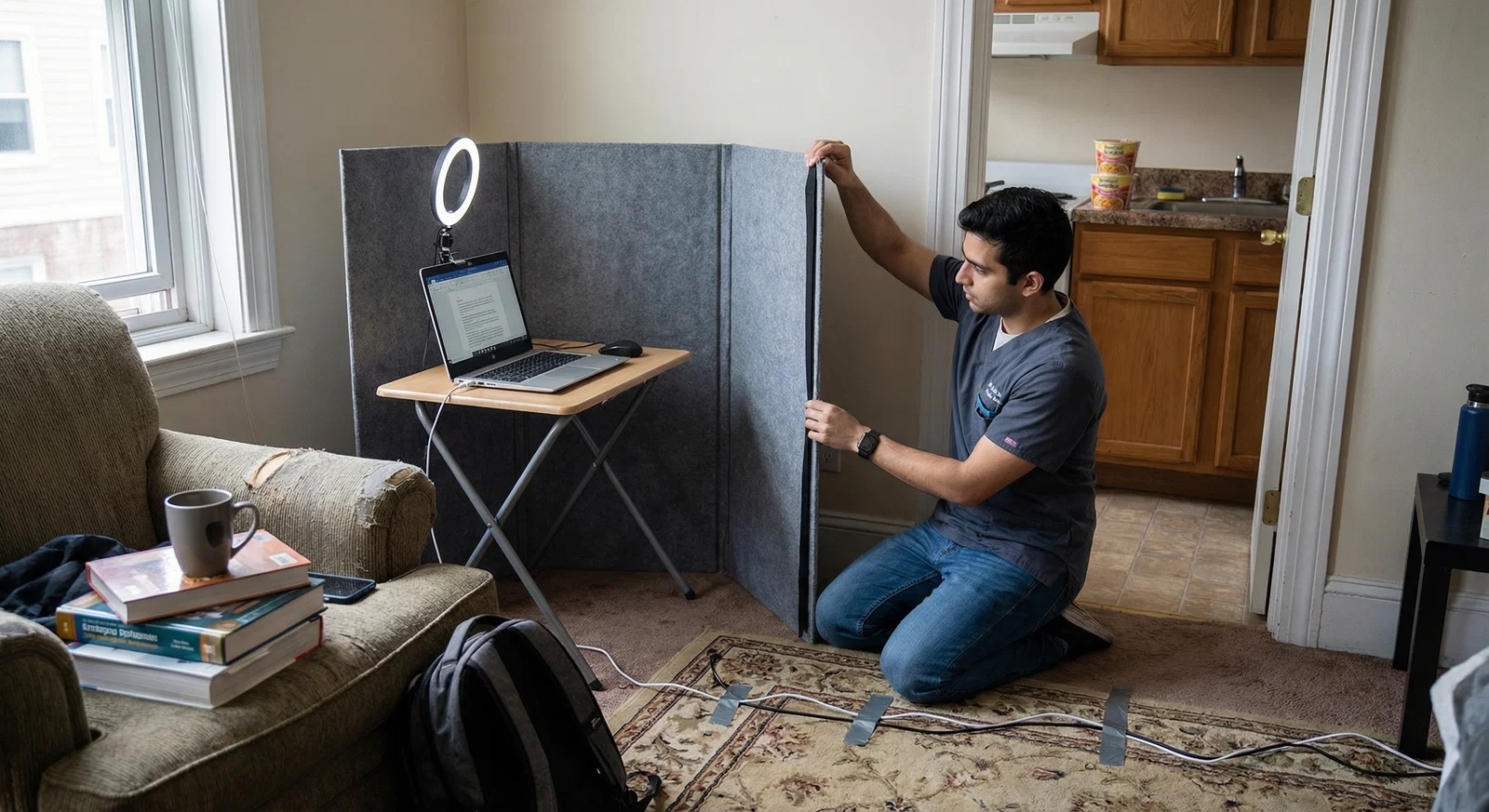
9) Your setup is distracting (virtual)
What it can signal: lack of planning or professionalism, even if your skills are strong.
Common early issues: loud background, poor lighting, an unflattering low camera angle, phone notifications, unstable internet, multitasking.
Do this instead:
- Face a window or use a lamp in front of you.
- Camera at eye level.
- Close extra tabs, silence notifications, and put your phone out of reach.
- Keep notes to one page so you are not obviously reading.
Recruiter vs manager: what changes
The first 10 minutes can look different depending on who you are talking to:
- Recruiter screen: more logistics and basics (timeline, compensation range, work authorization, location, high-level fit). Clarity and alignment matter most.
- Hiring manager: more role specifics (how you work, how you think, what results you can repeat). Clean examples and practical judgment matter most.
Phone screens: extra tips
No camera means they are listening harder for confidence, clarity, and attention.
- Stand or sit upright and smile while you speak. Your voice will sound more engaged.
- Keep your resume and the job description in front of you, plus a short notes page.
- Avoid typing loudly. If you are taking notes, say, “I am going to jot that down.”
- Pause before answering so you do not talk over them. Phone lag is real.
How to recover fast
I want you to hear this clearly: a shaky start does not automatically ruin an interview. Many hiring managers will reset their impression if you show self-awareness and finish strong.
Use a quick reset script
If you sense you are off track, try:
- “I want to make sure I am answering what you are asking. Are you most interested in the outcome, or the steps I took?”
- “Let me restart that more clearly.”
- “That is a great question. Can I take a moment to organize my thoughts?”
Anchor back to the job
Recovery works best when you connect your next answer to what they need. Pick one priority from the posting and deliver a clean example with a result. This is one of the most reliable turnarounds I have seen in real interviews.
Example pivot: “If it helps, one of my strongest areas is reducing errors through checklists and handoffs. In my last role…”
Ask one strong question earlier
A thoughtful question can change the tone from “interrogation” to “conversation.” In the first half of the interview, consider asking:
- “What would a successful first 60 to 90 days look like in this role?”
- “What are the biggest priorities you need this hire to take off your plate?”
- “What is the team’s communication style day to day?”
Do not apologize repeatedly
One clean apology for being late or for a tech hiccup is enough. Repeated apologies create a new problem: the interviewer now has to reassure you, and that is not the job.
First 10-minute checklist
- Before you join: job description open, notes ready, water nearby, notifications off
- First impression: greeting, eye contact, calm pace
- Your intro: 60-second Present-Past-Point
- Proof: one early accomplishment with numbers or outcomes
- Interest: one specific reason you want this role
- Recovery: “Let me restart that more clearly” if needed
Special cases
If you are a new grad
Red flag interviewers worry about: you cannot connect school to the job.
Your fix: translate projects and clinicals into outcomes.
- “In my capstone, my role was…, and the result was…”
- “During clinicals, I learned to prioritize by…, and I improved at…”
If you are transitioning from the military
Red flag interviewers sometimes misread: heavy jargon or job titles they do not understand.
Your fix: say it in plain language first, then add context.
- “I led a 12-person team responsible for equipment readiness. In civilian terms, it is like operations and inventory control.”
If you are interviewing for nursing roles
Early red flag: sounding casual about safety, documentation, or teamwork.
Your fix: weave in patient safety and communication naturally.
- “My priority is safe care and clear handoffs. For example…”
If you are interviewing for remote tech roles
Early red flag: you cannot explain how you stay accountable without in-person supervision.
Your fix: mention your systems.
- “I use a daily task list, weekly priorities, and I document updates in the ticket so stakeholders are not guessing.”
FAQ
Do interviewers decide in the first few minutes?
Many interviewers form an early impression, yes. Strong interviewers keep an open mind, and a clear reset can change the tone quickly. Your goal is to avoid avoidable mistakes early, then back it up with specific examples.
What is the biggest red flag in an interview?
In my experience, it is lack of preparation because it shows up everywhere: vague answers, not understanding the role, weak questions, and low confidence.
How do I recover from a bad answer?
Say, “Let me restart that more clearly,” then answer with a short structure (Context, Action, Result) . One clean reset is more impressive than pushing through a messy answer.
What if I cannot remember an example on the spot?
Buy a few seconds and choose something simple: “Let me think for a moment.” Then use a smaller example from a project, shift, or class. Interviewers prefer a modest, clear story over a dramatic story you cannot explain.