A crisp fold and a fresh perspective.
If you have something in your past from before you turned 18, it is natural to wonder whether it is “sealed away” for good. Juvenile records are not the same as adult convictions, and the rules around privacy and reporting are often tighter. But here is the key: tighter rules do not mean a juvenile record is always invisible.
Whether a juvenile record shows up on a pre-employment background check depends on where you live, what kind of record it is, how the case was handled, and what the employer is checking for. Let’s unfold what can happen and how to respond in a way that is honest, calm, and protective of your options.

Juvenile record vs adult conviction
One of the most important distinctions to keep straight is that a juvenile adjudication is usually not called a “conviction.” In many states, juvenile court focuses on rehabilitation, and outcomes may be recorded as an adjudication, a delinquency finding, or a similar term rather than a criminal conviction.
That said, employers and background check companies do not always use the same everyday language you see in court. A report might still show an entry tied to a juvenile case, especially if the record is not sealed, the case was handled in adult court, or the check is run for a job with special screening rules.
Why that difference matters
- Application wording: Many forms ask about “convictions,” not “charges” or “court records.” If your juvenile history is not legally a conviction, the right answer may be different than you fear.
- Reporting rules: Some jurisdictions restrict reporting of juvenile matters more than adult matters, but those restrictions vary widely.
- Job-specific screening: Certain regulated roles can trigger deeper review or different access to records.
So, will it show up on a background check?
Sometimes yes, sometimes no. The outcome depends on a few practical factors.
1) Your state’s confidentiality and sealing rules
States differ on what is confidential by default, what can be sealed or expunged, and what remains visible to certain parties. Even within the same state, the rules can differ based on the offense type and the outcome of the case.
Terminology varies, too. In some places, “expunged” can mean destroyed. In others, it means restricted or sealed from public view. “Sealed” often limits access without erasing the record for every purpose.
2) Whether the case stayed in juvenile court
If a case was transferred, waived, or otherwise handled in adult court, it can be treated like an adult criminal matter for reporting purposes, even if you were under 18 at the time. That includes situations where you were charged or processed in adult court, not just cases that ended in an adult conviction.
3) The job and the type of check
Some employers run only a basic county or state criminal search. Others run more expansive searches or require specific clearances.
Roles that commonly trigger deeper screening include:
- School, childcare, and youth programs
- Healthcare and elder care
- Financial services and roles handling money
- Security-sensitive jobs, government roles, or positions requiring a clearance
The exact scope is often spelled out in the background check disclosure and authorization forms you sign.
4) Whether the record is restricted and whether databases have caught up
If a juvenile record has been sealed or expunged, it is often less likely to appear in a routine pre-employment check. Still, outcomes are state-specific, and some juvenile information can be public in certain jurisdictions or for certain offenses.
Also, commercial background check databases can lag behind court updates. A record can be sealed in the courthouse and still surface in a third-party report until data sources are refreshed, corrected, or disputed.

What employers can ask
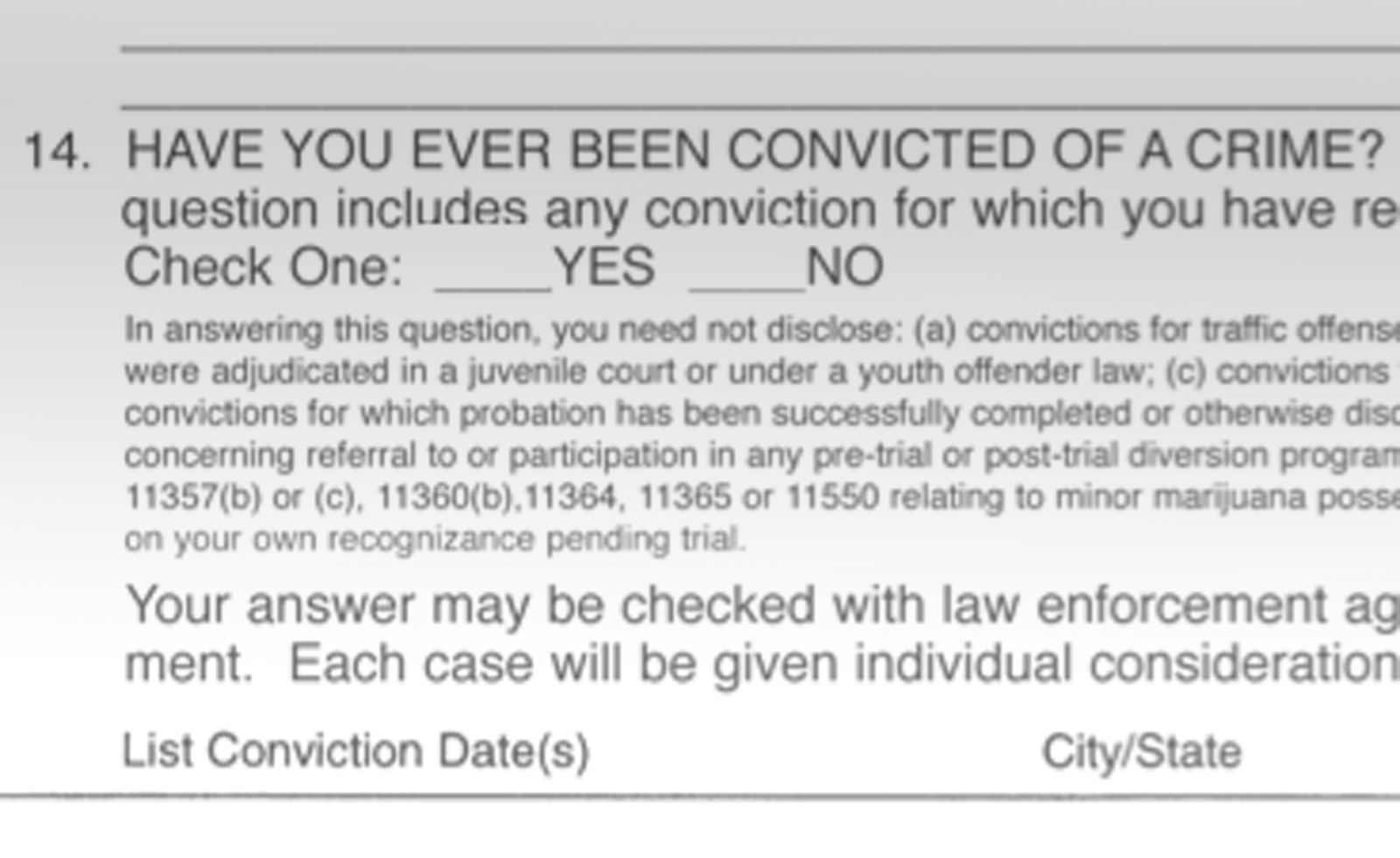
Most application stress comes down to one line: “Have you ever been convicted of a crime?” But forms are not consistent. You might see variations like:
- “Have you ever been convicted of a misdemeanor or felony?”
- “Have you ever been adjudicated delinquent?”
- “Have you ever had a record sealed or expunged?”
- “Have you ever been arrested?”
- “Do you have any pending charges?”
Read the question literally. A juvenile matter might not be a conviction, but if the form asks about arrests, charges, or juvenile adjudications, you may be required to disclose it.
One more timing wrinkle: in some states and cities, fair chance or ban-the-box laws limit when certain employers can ask about criminal history, and what they can consider. The legality and timing vary by location and employer type, so it is worth checking your local rules if you are seeing inconsistent practices.
If you are unsure what your juvenile outcome is legally considered in your state, consider getting a copy of your own record or speaking with a qualified attorney or legal aid clinic. Clarity beats guessing.
How to check your own record
If you want a steadier footing before you apply, you can often do some careful legwork up front. The exact steps depend on your state and on whether juvenile records are confidential by default.
- Ask the juvenile court clerk: In many places, juvenile files are not available for public browsing, but you may be able to request your own file, a docket summary, or proof of sealing.
- Check the adult court docket: If there was a transfer or waiver to adult court, the adult court may have a public case entry even if the incident began while you were a minor.
- Request a state repository record: Some states let you request your own criminal history record through the state police or a similar agency.
- Order your own consumer report: If you know which screening company an employer uses, you can ask how to request your file from that company. If you are denied a job based on a report, you generally have specific rights to get that report, too.
If you are trying to determine whether you qualify for sealing or expungement, a local legal aid clinic can often tell you quickly what the rules are in your county.
How to answer honestly
My guiding principle here is simple: do not hide a record the question asks for. If the form asks something you must disclose and you answer “no,” you risk a credibility issue later, even if the original incident was minor or long ago.
Use these principles
- Answer the question asked. Do not volunteer extra categories the form did not request.
- Be consistent. If you disclose on the form, be prepared for a follow-up question if the employer brings it up later.
- Keep it factual. A short, accurate explanation is usually better than a long story.
- Focus on what changed. Employers typically care about current risk and reliability. You can emphasize growth, stability, and the time that has passed.
Example responses
If the application asks only about convictions:
- “No.” (If your juvenile matter is not legally a conviction and the question is truly limited to convictions.)
If the application asks about juvenile adjudications or court findings:
- “Yes. It was a juvenile matter from my teens that has been resolved. I can share more context if needed.”
If the application asks about arrests or charges:
- “Yes. This occurred when I was a minor and the matter is closed.”
One caution: in some jurisdictions, employers cannot ask about arrests or non-convictions at certain stages, and some are restricted from considering them at all. But if the question is lawful where you are and it clearly applies to you, do not answer falsely.
If your background check report is wrong
Errors happen more often than people expect. Common issues include:
- Someone else’s record matched to you due to a similar name or birthdate.
- A sealed or expunged juvenile matter still showing due to a stale commercial database.
- A disposition listed incorrectly, such as showing a conviction when the case was dismissed.
- Duplicate entries from multiple sources.
Step 1: Get the report and notices
If a third-party consumer reporting agency ran the check, you generally have the right to request a copy of your report.
If an employer may take negative action based on the report, they typically must give you a pre-adverse action notice that includes a copy of the report and a Summary of Rights under the Fair Credit Reporting Act. After a final decision, they generally must provide an adverse action notice. State laws may add protections or extra steps.
Step 2: Dispute with the screening company
Follow the dispute instructions provided by the screening company. Be specific about what is wrong and why. Include supporting documents if you have them, such as court paperwork showing the correct disposition or proof of sealing or expungement.
Step 3: Fix it at the source, if needed
Sometimes the issue is not the screening company but the underlying court record or database. If the court record itself is incorrect or incomplete, you may need to contact the court clerk or the agency that maintains the record.
Step 4: Move quickly during hiring
If you are in an active hiring process, respond quickly. If you need time to get documents, you can still file the dispute and follow up with additional proof.

If it appears and it is accurate
If the entry is accurate and the employer asks about it, your goal is not to relive every detail. Your goal is to show stability and readiness.
- Confirm the basics: what it was and that it is closed.
- Keep it in the past: note how long ago it happened.
- Point to your track record: school, work history, training, volunteer roles, references.
- Highlight what you learned: a short sentence is enough.
If you think the record might be eligible to be sealed or expunged in your state, consider looking into that process. Many people qualify without realizing it, especially if they have stayed out of trouble and completed all court requirements.
Quick FAQ
Can an employer see sealed juvenile records?
Often, sealing restricts what is visible in routine checks, but exceptions can exist depending on the state, the type of job, and the agency involved. Licensing boards and some government roles may be able to access records that a private employer cannot. If your record is sealed and it still shows up in a standard employment report, that can be a sign of an outdated database or a reporting error worth disputing.
Do I have to disclose a juvenile record if the application only asks about convictions?
Not always. Many juvenile outcomes are not legally “convictions.” But wording matters, and some applications ask broader questions that would require disclosure.
What if the application asks about arrests?
If the question is lawful where you are and it asks about arrests, and you were arrested as a juvenile, you may have to answer “yes” even if the case was dismissed. In other places, fair chance laws restrict asking about arrests or non-convictions, especially early in the process. Because the rules vary, treat this as a signal to check your local law and the employer’s policy.
Will a juvenile record show on every background check?
No. Different employers run different checks, and record accessibility varies by state, by the type of juvenile record, and by whether the case touched adult court.
The fold to remember
A juvenile record is not the same as an adult conviction, and many juvenile records have extra privacy protections. Still, you should not assume it is invisible. Read the application question closely, answer honestly, and if a report contains incorrect information, dispute it promptly with documentation.
When you handle it directly, you protect your credibility and keep the focus where it belongs: on the work you are ready to do next.