When I was hiring for roles that required quick thinking, I wasn’t just watching for the “right answer.” I was listening for how a candidate made sense of uncertainty in real time. That’s what many case interviews are designed to surface. It’s a live problem-solving conversation where you clarify a messy business question, build a structure, do some math, and communicate your thinking clearly under pressure.
This guide walks you through how to prepare for that performance without turning your prep into memorizing a thousand cases. We’ll focus on the skills that transfer to almost any prompt: clarifying, structuring, prioritizing, calculating out loud, reading information quickly, and landing a recommendation.

What a case interview is
A case interview is a timed, interactive problem where the interviewer plays the role of a client or stakeholder. You are asked to diagnose a situation and recommend an action. Depending on the company and role, you might get a market sizing question, a profitability problem, a growth strategy prompt, or an operations scenario.
Unlike behavioral questions, a case is not about narrating your past. It’s about how you:
- Clarify an unclear ask and define success.
- Structure a big problem into manageable buckets.
- Prioritize what matters most with limited time and data.
- Analyze with clean logic and accurate math.
- Communicate like a calm colleague, not a student taking a test.
- Adapt when the interviewer pushes back or new facts show up.
You can absolutely be new to consulting or analytics and still perform well if your approach is disciplined and your communication is clear.
Common case formats
Not every company runs cases the same way. Knowing the format helps you adjust your behavior without changing your fundamentals.
Interviewer-led cases
The interviewer controls the flow. Your job is to answer the question in front of you, show organized thinking, and synthesize often. Do not fight the steering. Treat it like a collaborative work session.
Candidate-led cases
You drive. That means you need to propose a plan, choose what to analyze next, and ask for the right data. This is where prioritization and hypothesis-driven thinking matter most.
Exhibit-heavy or written cases
You may get charts, tables, or a short packet to read. Your edge comes from reading quickly and cleanly:
- Start with the title, axis labels, and units.
- Call out the trend in one sentence.
- Quantify it with 1 to 2 numbers.
- Say what it implies for the decision.
Your prep plan in three phases
Phase 1: Build the core mechanics
- Practice writing a simple issue tree (your structure) from scratch in under 90 seconds.
- Drill mental math and clean calculations with clear assumptions.
- Get comfortable speaking while you calculate and while you think.
Phase 2: Practice live, not just reading
- Do live mock cases with a friend, mentor, or coach 3 to 5 times per week if you can.
- Record yourself at least once. You’ll catch filler words, rushed explanations, and messy math habits fast.
- After each mock, review: structure quality, prioritization, math accuracy, exhibit reading, and communication.
Phase 3: Tighten and personalize
- Develop 2 to 3 go-to structures you can adapt (profit, growth, operations).
- Practice closing recommendations with clear tradeoffs and risks.
- Calibrate to the role: consulting, product, finance, ops, or analytics.
Step 1: Clarify the question
Strong candidates do not sprint into a framework. They slow down for 20 to 60 seconds and make sure they are solving the right problem.
What to clarify
- The objective: “When you say success, do you mean maximize profit, increase revenue, reduce cost, or something else?”
- The metric: “Are we targeting profit dollars, profit margin, or market share?”
- The time horizon: “Is this a 3-month fix or a 3-year strategy?”
- The scope: “Is this for one region, one product line, or the whole business?”
- Constraints: “Any limits on budget, headcount, pricing, or regulation?”
A simple clarification script
“Let me repeat the prompt in my own words to confirm I’m aligned.” We’re trying to increase profit for the company’s North America business over the next 12 months. “Before I lay out an approach, can I ask two quick clarifying questions” about how you want to measure profit, and whether there are any constraints on pricing changes?
This does two things at once: it prevents you from solving the wrong case, and it signals executive-level communication.

Step 2: Build a structure
Your structure is your roadmap. Interviewers want to see that you can break a big ambiguous question into logical parts that cover the full problem without wandering.
What good structure looks like
- Mutually exclusive: no overlapping buckets.
- Collectively exhaustive enough: you cover the likely drivers.
- Driven by the prompt: you choose buckets that match the goal.
- Actionable: each branch suggests data to request or analysis to run.
Three adaptable structures
1) Profitability (when profit is down or needs improvement)
- Revenue = price × volume
- Costs = fixed + variable
- Product or customer mix
- Operational drivers (capacity, utilization, process)
2) Growth (when the goal is “grow”)
- Grow core business (more customers, higher frequency, higher basket, higher retention)
- Expand to new segments or geographies
- New products or channels
- Risks and capabilities required
3) Operations (when the issue is delivery, efficiency, or quality)
- Demand and forecasting
- Supply and capacity
- Process bottlenecks
- People, tools, and controls
- Quality, rework, compliance
How to present your structure
Don’t just write quietly. Narrate the map.
“I’m going to break this into three areas.” First, I want to understand revenue drivers, meaning whether price or volume changed. Second, I want to understand cost drivers, especially variable costs per unit. Third, I want to check constraints like capacity limits or competitive pressure that might limit our options. Then we can prioritize which lever is likely biggest. Does that sound reasonable?
Step 3: Prioritize
This is where many candidates freeze. They build a great structure, then they ask for data in a random order.
Your job is to choose the most promising branch first and explain why.
Use a starting hypothesis
You are not guessing wildly. You are making an informed starting point and staying flexible.
- “Given profit is down, I’d like to start by checking whether volume fell, variable cost rose, or our mix shifted.” Those are common drivers to test early.
- “Since this is a new market, I want to start with market size and willingness to pay.” If the market is too small or customers will not pay, nothing else matters.
A clean prioritization phrase
“To be efficient with time, I’ll start with volume because it tends to explain big profit moves quickly when it changes.” If volume is stable, I’ll move to price and then variable costs per unit, and I’ll keep an eye on mix the whole time.
This shows you can manage ambiguity like an analyst or consultant, not like someone hoping the interviewer rescues them.
Step 4: Do the math out loud
In case interviews, math is often straightforward. But it’s almost always live. What interviewers care about is whether your math is accurate, whether your assumptions are reasonable, and whether you can explain your steps clearly. In some analytics, boutique consulting, or finance-heavy interviews, the math can get more advanced, so the habit of clear narration still pays off.
Rules for talking through math
- State the formula first: “Profit equals revenue minus costs.”
- Say your assumptions explicitly: “I’ll assume 365 days in a year and round for speed.”
- Round intentionally: “I’m rounding 9.8 million to 10 million to simplify.”
- Do one step at a time: avoid long silent stretches.
- Sanity check at the end: “Does this number make sense given what we know?”
How to handle a mistake
If you catch an error, don’t spiral. Correct it calmly.
“Let me correct that.” I multiplied by 12 when it should have been 52 weeks. With 52, the annual figure is closer to…
That recovery is often more impressive than never making a mistake at all.
Step 5: Ask for data well
Case interviews are a collaboration. You do not need to hoard information, and you do not want to pepper the interviewer with 12 questions at once.
Data request best practices
- Ask for the specific data tied to your structure: “Do we have last year versus this year volume and price by product?”
- Explain what you will do with it: “That will let me isolate whether the revenue change is price-driven or volume-driven.”
- Be comfortable with “we don’t have that”: propose a proxy or assumption.
- Summarize after new info: “So far, we’ve learned X and Y. Next I want to test Z.”
If you come from a military background or any environment where you were trained to execute quickly, this can feel unnatural at first. In consulting-style cases, pausing to align and summarize is not weakness. It’s professionalism.
Step 6: Communicate clearly
Interviewers are imagining you in front of a client, a nurse manager, a product lead, or a CFO. The most common reason strong candidates underperform is not logic. It’s communication.
What strong case communication sounds like
- Signposting: “First I’ll look at revenue, then costs.”
- Checkpointing: “Before I go further, does this direction make sense?”
- Summarizing: “The key driver appears to be volume decline in Segment A.”
- Using numbers clearly: “Revenue dropped about 10 percent year over year.”
Replace filler words with a pause
If you tend to say “um,” “like,” or “you know,” practice simply pausing while you think. Silence feels longer to you than it does to the interviewer. A two-second pause reads as composure.
Step 7: Close the case
Your ending matters. A case interview is not complete until you make a decision and support it.
A strong recommendation has four parts
- Answer first: “I recommend we pursue X.”
- Key reasons (2 to 3): tie to your analysis and numbers.
- Risks and tradeoffs: show realism.
- Next steps: what you would test or do in the first 30 to 90 days.
A recommendation script you can practice
“Based on what we’ve seen, I recommend we focus on restoring volume in Segment A before we touch pricing.” In this case, Segment A is the company’s mid-market subscription tier, and we’re seeing churn spike after a recent onboarding change. The biggest drivers are a 12 percent unit decline in Segment A and a higher churn rate in our highest-margin customers. The main risks are that discounts could train customers to wait for promos, and that competitors may match any offer quickly. We can mitigate that by using targeted retention offers, improving onboarding for at-risk customers, and setting a clear end date for promotions. Next, I’d prioritize a quick customer cohort analysis and a two-market pilot to confirm the lift before rolling anything out nationally.
How to practice without memorizing
You will improve faster by training transferable skills than by trying to collect endless case prompts.
Skill drills that work
- One-minute structure: read a prompt, build a structure on paper in 60 to 90 seconds, then explain it out loud.
- Mental math reps: percentages, multiplication, break-even, weighted averages, units conversion.
- “Explain it to a smart friend” drill: take one insight and explain it in two sentences, then in one sentence.
- Recommendation practice: set a timer for 45 seconds and deliver a clear close.
Mock case checklist
- Did I restate the problem and confirm the objective?
- Was my structure clear and tailored to the prompt?
- Did I prioritize logically?
- Was my math organized and spoken clearly?
- Did I read any exhibits correctly and quickly?
- Did I synthesize along the way?
- Did I end with a direct recommendation and next steps?
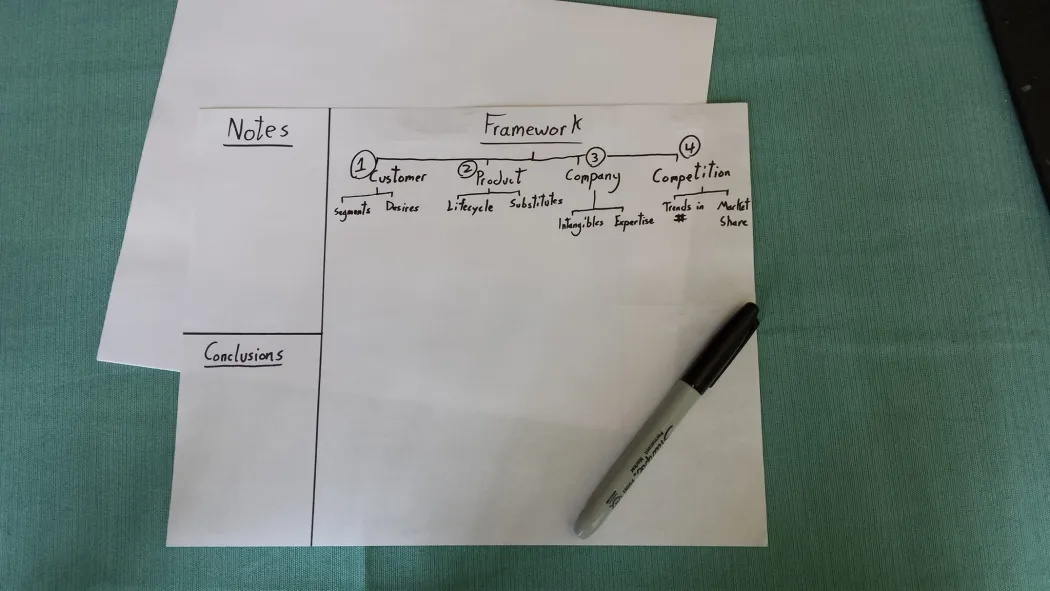
Note-taking that helps
If your notes are messy, your thinking will look messy even when it is not. A simple page layout makes a big difference.
- Top line: objective and key constraints.
- Left side: your structure or issue tree.
- Right side: math and calculations, clearly labeled.
- Bottom: running synthesis and final recommendation bullets.
When you get new data, write it once, label it, and refer back to it. This keeps you from re-asking questions you already answered.
Common mistakes
Rushing into a framework
Fix: restate the prompt and ask 1 to 3 clarifying questions first.
Using a generic structure that doesn’t fit
Fix: choose buckets that match the objective. A pricing problem is not a market entry problem.
Getting lost in the weeds
Fix: timebox your analysis. If a path is low impact, say so and move on.
Silent math
Fix: narrate: formula, assumptions, steps, sanity check.
No synthesis until the end
Fix: summarize after each major chunk: “So far, we know X. That suggests Y.”
Quick prep checklist
- Can you build a tailored structure in under 90 seconds?
- Can you talk through math calmly and clearly?
- Can you summarize insights as you go?
- Can you end with an answer-first recommendation, risks, and next steps?
- Have you done at least a few live mocks out loud, not just reading?
FAQ
How long should I take to structure the problem?
In most interviews, 60 to 90 seconds is a good target. It’s fine to ask for a brief moment to organize your thoughts. Just don’t disappear into your notebook for five minutes.
What if I don’t know industry details?
You usually don’t need them. Use clear assumptions, ask for missing data, and focus on first principles: revenue, cost, customers, operations, constraints. If you do have relevant knowledge, mention it lightly, but don’t rely on it.
Is it okay to ask the interviewer questions during the case?
Yes. In fact, you should. The key is to ask questions that move your analysis forward, not questions that offload the thinking.
What if I get stuck?
Pause, summarize what you know, and propose a next step: “Based on what we’ve learned so far, I’d like to test whether customer churn is driving the volume decline. Do we have churn by segment over the last two quarters?” This shows you can recover and keep the work moving.
How do I practice if I don’t have a partner?
You can still improve a lot solo by doing one-minute structures, math drills, and recording yourself giving recommendations. If you can, add even one live mock per week, because the interaction is a big part of the challenge.