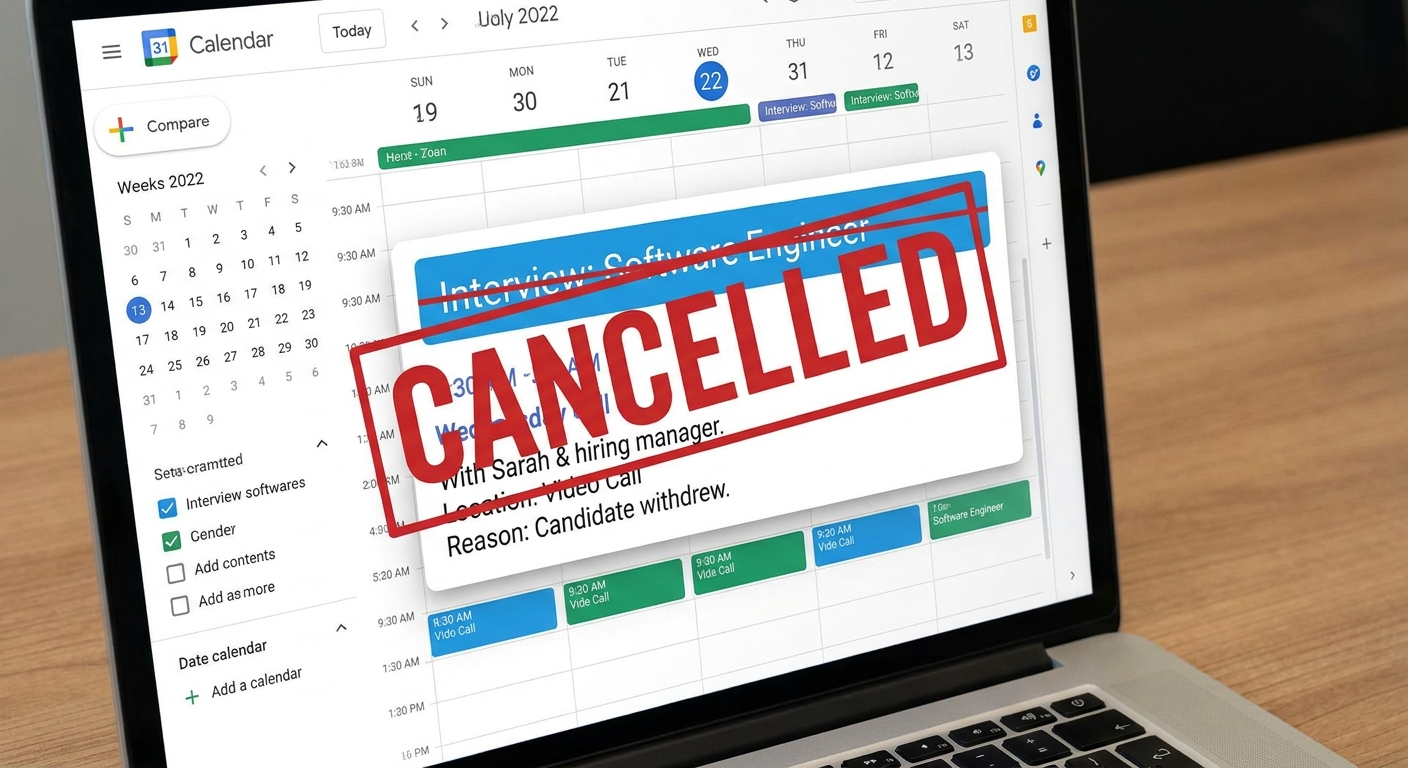
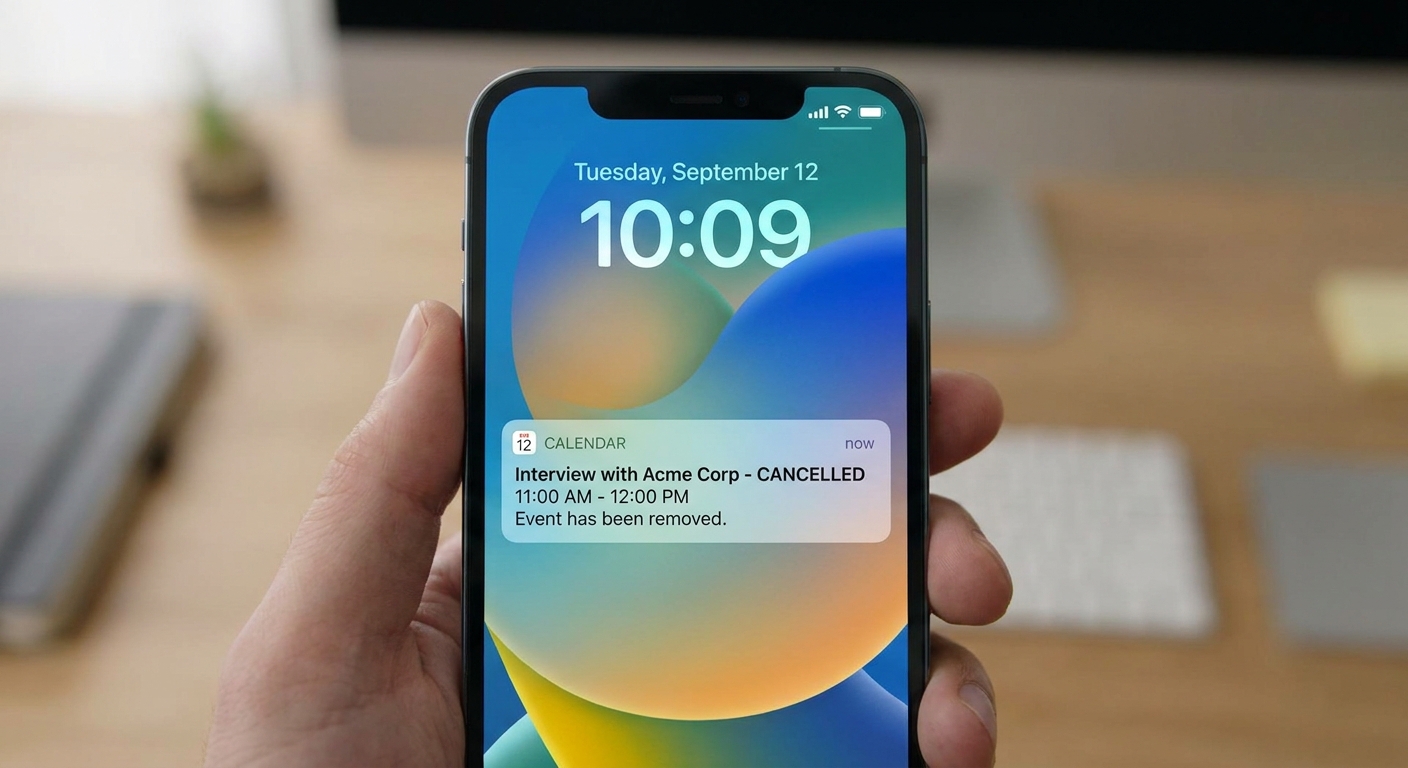
Few job search moments are more deflating than seeing “Interview Cancelled” pop up on your calendar, especially when you have prepped answers, arranged childcare, or taken time off work. I have been on the hiring side for years, and I can tell you this: cancellations happen for normal reasons, and they are not automatically a judgment on you.
What matters next is how you respond. A calm, professional reply keeps you in the running, protects your time, and gives you clarity about whether this opportunity is still real.
First, pause and read the cancellation
Before you type a reply, scan the message for clues that change your next step:
- Did they propose a new time? If yes, your job is mainly to confirm or offer two alternatives.
- Did they give a reason? A specific reason (illness, client emergency, travel delay) often signals a legitimate reschedule.
- Did they use vague language? Phrases like “we are moving in a different direction” or “we will be in touch” can signal the process is cooling off.
- Was it a recruiter, coordinator, or hiring manager? Coordinators often can reschedule quickly, but it depends on the team’s calendar and internal process.
- How close to the interview did they cancel? Same-day cancellations are frustrating, but they can still be genuine. Repeated last-minute changes are a different story.
Also do two quick practical checks before you assume the worst:
- Confirm you are replying to the right thread and contact. If the cancellation came from an automated scheduler, there is often a recruiter or coordinator you should include.
- Check spam and inbox rules. Reschedule links and calendar updates can land in unexpected places.
How to reply to an interview cancellation
Your response should do three things:
- Acknowledge the cancellation politely.
- Reaffirm interest in the role (if you are still interested).
- Make rescheduling easy by offering availability or asking for next steps.
When you propose times, include your time zone and confirm the format (phone, video, in-person). Small details prevent a second round of scheduling confusion.
Email example: Cancelled with no new time
Use this when the message stops at “we need to cancel” or “we will reach out to reschedule.”
Subject: Re: Interview for Marketing Manager
Hi Sarah,
Thank you for letting me know. I understand things come up.
I remain very interested in the Marketing Manager role and would be glad to reschedule. I am available Tuesday, November 12 from 10:00 a.m. to 12:00 p.m. ET or Thursday, November 14 from 2:00 p.m. to 4:00 p.m. ET. If another time works better, I can share additional options this week.
Also, please confirm whether this will be on Zoom as originally planned.
Best regards,
Jordan Lee
555-014-8821
Email example: Cancelled but they proposed a new time
Keep it simple. Confirm, or offer two alternatives.
Subject: Re: Interview for Data Analyst
Hi Miguel,
Thanks for the update. Yes, Thursday, November 14 at 11:30 a.m. PT works well for me. Please confirm whether this is still a phone interview or over Zoom.
Best,
Ashley Chen
Email example: Cancelled due to an internal delay
If they hint the role is on hold, your goal is to get a clear checkpoint date.
Subject: Re: Interview for Customer Success Lead
Hi Priya,
Thank you for the transparency. I am still very interested in the Customer Success Lead position and would like to stay in consideration.
When would be a good time for me to follow up on next steps, or should we tentatively hold a new interview date? If helpful, I am also happy to share additional information about my experience building onboarding processes and reducing churn.
Sincerely,
Daniel Rivera
What not to do: Do not guilt-trip them about your travel, demand an explanation, or write a long paragraph about how disappointed you are. Even when your frustration is valid, keep the reply short and steady. You can protect your time with boundaries in your follow-up timing, not with heat in your email.
If you incurred costs, you can keep it simple and factual, for example: “I had already booked travel for the original time. Should I hold off on rebooking until we confirm the new date?”
Should you ask for a new time?
In most cases, yes. If you want the job, it is appropriate and expected to ask to reschedule.
Ask for a new time when:
- The cancellation sounds logistical (scheduling conflict, illness, travel issue).
- They emphasize wanting to connect later.
- You still want the role and the company has otherwise communicated clearly.
Consider stepping back when:
- This is the second or third cancellation with no apology or plan.
- The role has been “on hold” multiple times without a concrete timeline.
- You are getting vague responses and long silences, and you have stronger leads elsewhere.
A boundary you can hold, without burning bridges, is this: you can be flexible, but you do not have to be endlessly available.
How long to wait to follow up
Timing depends on what they told you and how your industry typically moves. If you were not given a clear timeline, the cadence below is a common, reasonable approach.
If they proposed a new time
Reply the same day if possible. If the cancellation came in the evening, respond the next morning.
If they said “we will reschedule” but gave no date
Waiting about 1 business day is often enough. Then send a short follow-up if you have not heard anything. Many cancellations happen mid-chaos, and your polite nudge helps the coordinator close the loop.
If the interview was cancelled within a few hours
Reply that day to confirm you received it and ask about rescheduling. If you do not hear back, follow up the next business day.
If they cancelled because the role is paused
Ask when you should follow up. If they do not answer that question, a reasonable cadence is:
- One follow-up after about 7 to 10 business days.
- One final follow-up after another 10 business days.
After that, you can mentally file it as “not active” and focus your energy elsewhere while staying open to a future message.
Follow-up email examples
Follow-up #1 (after about 1 business day)
Subject: Re: Interview for Operations Coordinator
Hi Emily,
I wanted to follow up on rescheduling the interview for the Operations Coordinator role. I am available Wednesday, November 13 from 9:00 a.m. to 11:00 a.m. CT or Friday, November 15 from 1:00 p.m. to 3:00 p.m. CT, and I am happy to adjust if another time is better.
Thank you,
Sam Patel
Follow-up #2 (final check, about 7 to 10 business days later)
Subject: Checking in: Operations Coordinator interview
Hi Emily,
Just checking in to see whether the team is still moving forward with interviews for the Operations Coordinator role. If the position is on hold or has been filled, I would appreciate any update you are able to share.
Thank you for your time,
Sam Patel
Polite close-out (if you are done)
Use this if repeated cancellations have made you lose confidence, or you accepted another offer.
Subject: Re: Interview for Operations Coordinator
Hi Emily,
Thank you for the update and for considering me for the role. At this point, I am going to withdraw from the process.
I appreciate your time, and I wish you and the team the best with the search.
Best regards,
Sam Patel
When to treat it as closed
This part is tough, especially if you were excited. In recruiting, silence is not always a “no,” but there are patterns that usually mean the opportunity is effectively over.
It is reasonable to treat the process as closed when:
- You have followed up twice and heard nothing for around 2 to 3 weeks, and you were not given a timeline.
- They cancelled and removed the job posting, and nobody confirms next steps.
- They repeatedly cancel with no attempt to reschedule.
- Communication becomes inconsistent (different contacts, conflicting messages, no ownership).
What I tell clients: close the emotional tab, not necessarily the logistical tab. You can keep the door open by staying polite and responsive, but you should reallocate your time to active leads.
If it feels like a red flag
Sometimes an interview cancellation is your first glimpse of what working there might feel like. A single cancellation is normal. A pattern can be a warning.
Potential red flags
- Multiple cancellations with no apology or acknowledgement of your time.
- Pressure to interview immediately after cancelling, with no regard for your schedule.
- Disorganization plus odd requests (for example, asking for sensitive information early, pushing you to communicate only via unofficial channels).
- Repeated “urgent” reschedules paired with long silence.
A boundary-setting response
Hi Sarah,
Thanks for the update. I am available to reschedule on Monday, November 18 at 1:00 p.m. ET or Tuesday, November 19 at 9:30 a.m. ET. If neither of those works, I can share additional times, but I do need to confirm at least 24 hours in advance due to work commitments.
Best,
Jordan Lee
This keeps you respectful while signaling that your time is not unlimited.
Special situations
If you already took PTO, paid for travel, or arranged childcare
You do not need to mention every detail, but it is okay to note a constraint so they take scheduling seriously next time.
Hi Miguel,
Understood, thank you for letting me know. I would be happy to reschedule. Because I will need to coordinate time away from work, could we confirm a new time at least 24 hours in advance?
Thank you,
Ashley Chen
If the cancellation came from an automated system
Reply anyway, and if you have a recruiter or coordinator contact, copy them. Automated cancellations sometimes happen when a calendar link is changed, not because they are no longer interested.
If you are a military veteran or currently serving
If your availability is shaped by drills, appointments, or transition requirements, you can briefly name that constraint without over-explaining.
Hi Priya,
Thank you for the update. I would be glad to reschedule. I am available Thursday, November 14 after 3:00 p.m. ET or Friday, November 15 between 9:00 a.m. and 11:00 a.m. ET, and I will need to lock in the final time due to a standing service-related commitment.
Respectfully,
Daniel Rivera
Checklist: best next move
- Reply within one business day when you can.
- Keep it to 6 to 10 lines whenever possible.
- Reconfirm interest (only if genuine).
- Offer two specific time windows and include your time zone.
- Confirm the interview format (phone, video, in-person) and the right contact.
- If they do not respond, follow up once, then once more as a final check.
- After about 2 to 3 weeks of silence with no timeline, treat it as closed and move on.
FAQ
Is it unprofessional to ask why it was cancelled?
If they did not provide a reason, it is usually better to focus on rescheduling than to press for details. You can ask a neutral question like, “Is the role still moving forward?” if you need clarity.
Should I call instead of email?
Email is often best because it creates a clear record and makes scheduling easier. That said, some teams move faster by phone or text, especially when a recruiter is coordinating multiple calendars. If you do call, follow up in writing afterward.
What if they cancel twice?
Reschedule once more if you still want the role, but tighten your boundaries. Ask to confirm at least 24 hours in advance, and pay attention to whether they take ownership of the disruption.
Does a cancellation mean I did something wrong?
Most of the time, no. Hiring teams cancel for business reasons, internal emergencies, and scheduling breakdowns. Your goal is to respond professionally, protect your time, and watch for patterns.